
The Accountability Trap: Why School Systems Abandon Gifted Students
How testing metrics and funding formulas leave our brightest learners behind

There’s a little secret in American public education that administrators rarely admit out loud: gifted students have become expendable.
Not because educators don’t care. Not because teachers lack compassion. But because the very systems designed to improve schools have created perverse incentives that make neglecting high-ability learners the rational choice for survival.
The Problem Hiding in Plain Sight
In a revealing 2017 study published in Roeper Review, researchers interviewed all nine elementary principals in a Virginia school district about whole-grade acceleration, which is one of the most well-researched interventions for gifted students. The findings were stark.
When asked about their priorities, Principal Carter’s response revealed the uncomfortable truth at the heart of our system: “Unfortunately, my frame of reference is getting the overall pass rate up. So, I focus a lot of energy on the students that are not doing well.”
This isn’t an isolated problem. It’s systemic. And the long-term research proves we’re making a catastrophic mistake.
The 35-Year Evidence We’re Ignoring
A groundbreaking 2021 study published in the Journal of Educational Psychology tracked over 1,600 intellectually gifted students for 35 years to examine whether acceleration harms psychological well-being in adulthood. The researchers followed three cohorts of students identified between 1972 and 1983, measuring their psychological flourishing, life satisfaction, and emotional well-being at age 50.
The results were unequivocal: Academic acceleration showed zero association with psychological harm. Whether students graduated high school early, skipped grades, or took advanced courses, their long-term well-being was not detrimentally affected, as some presume.
Even more striking: these accelerated students scored above average on every measure of psychological well-being compared to national norms. They were thriving.
The researchers replicated these findings with a separate cohort of elite STEM graduate students, confirming the results held across different populations and time periods. The correlation between acceleration and age-50 psychological well-being hovered around zero across all measures.
Yet in schools across America, principals continue citing unfounded social-emotional concerns to deny gifted students the advanced learning opportunities research shows they desperately need.
The Texas Two-Step: How Accountability Crushes Gifted Education
Texas provides perhaps the clearest example of how state accountability systems create these warped priorities. Let me walk you through how the incentive structure actually works.
The Ratings Game
Texas schools receive A-F accountability ratings based on three main domains:
Student Achievement - Evaluates performance on STAAR tests, graduation rates, and College, Career, and Military Readiness (CCMR) indicators
School Progress - Measures academic growth, particularly focusing on students moving from “Does Not Meet” to “Approaches Grade Level”
Closing the Gaps - Reviews achievement differentials among racial/ethnic groups and socioeconomic backgrounds
Notice what’s missing? There’s no meaningful measurement of whether advanced students are being challenged or growing beyond grade-level standards.
The Funding Formula
Here’s where it gets more insidious. Texas uses a “student-based allotment” funding model where districts receive additional weights (extra funding multiplied by the basic allotment of $6,215) for different student populations:
Special education students: weights ranging from 1.15 to 5.0 depending on intensity of services (no caps)
Economically disadvantaged students: weight of 0.275 (compensatory education)
English language learners: weight of 0.1 (bilingual/ESL)
Gifted students: weight of 0.07, capped at only 5% of students and $100 million statewide
Let’s be clear about what this means in practice:
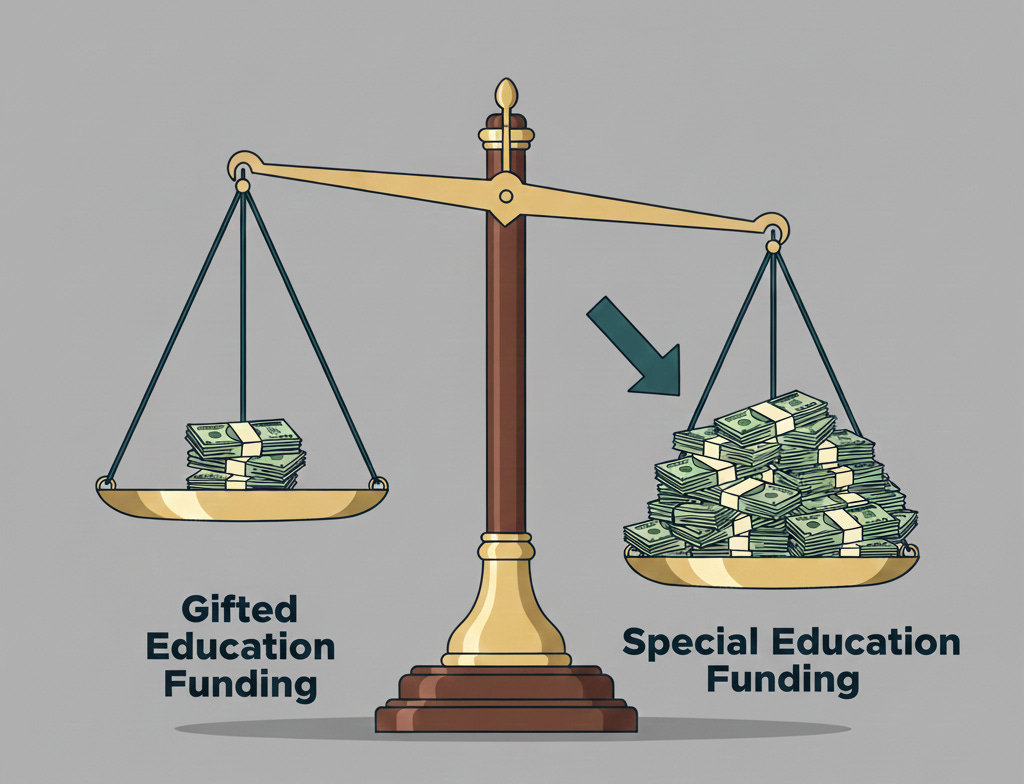
A special education student in a resource room setting generates funding at a 3.0 weight — more than 40 times what a gifted student generates. A student receiving the most intensive special education services generates funding at a 5.0 weight — more than 70 times the gifted weight.
And unlike special education, which has no enrollment caps, gifted funding is limited to just 5% of a district’s students with a statewide cap of $100 million annually. This means that even if a district identifies more than 5% of students as gifted (which research suggests is appropriate), they receive no additional funding for those students.
The gifted weight of 0.07 wasn’t even part of the formula until 2021, when it was reinstated by House Bill 1525 after years of having zero funding weight at all.
The Rational Response
From a purely administrative standpoint, the incentive structure is crystal clear:
Ratings depend on moving struggling students to “passing” → Invest resources in intervention programs
Special education funding is 40-70x higher than gifted funding → Hire reading specialists, math interventionists, RTI coordinators
No accountability for advanced achievement → Gifted programs become optional extras
Gifted funding is capped and minimal → One gifted coordinator serves 1,000+ students across entire districts
As the Sheppard study documented, principals explicitly acknowledged this calculus. Eight of nine principals focused their attention on low-achieving students, with school improvement plans centering entirely on raising minimum performance levels.
What This Looks Like on the Ground
The consequences aren’t abstract. Here’s how this plays out in real Texas classrooms:
The Differentiation Myth: Teachers are told to “differentiate” for gifted students in heterogeneous classrooms—often while managing 25+ students at wildly different levels, with formal training, support, and accountability focused almost exclusively on struggling learners. As Principal Carter noted in the study, it seemed easier to keep gifted students “at grade level and asking the teacher to differentiate for that one child” rather than consider acceleration.
The Lock-Step Mandate: Even when students demonstrably need different instruction, schools maintain rigid age-based grade progression. The Virginia study found that four principals explicitly mentioned the expectation that “all students must be lock-step with age peers.” In Texas, this is reinforced by accountability systems that don’t measure—and therefore don’t value—advanced achievement.
The Expertise Gap: Seven of nine principals in the study had participated in some gifted education training, but zero had received training on acceleration. When asked about research, eight of nine admitted they had done no research on acceleration. Meanwhile, these same administrators could cite extensive research on retention and interventions for struggling students.
The Funding Reality: Even when Texas reinstated gifted funding in 2021, districts still lose money by serving gifted students well. With only a 0.07 weight capped at 5% of students, comprehensive gifted programming remains a net financial loss compared to the lucrative funding streams for special education and compensatory education.
The Research They’re Ignoring
Here’s the tragedy: the research on acceleration is overwhelming and unambiguous.
The 35-year longitudinal study found that students who experienced acceleration:
Showed no deficits in psychological well-being at age 50
Scored above national averages on measures of life satisfaction, positive affect, and psychological flourishing
Demonstrated comparable or better social-emotional development than non-accelerated peers
Experienced zero negative correlation between amount of acceleration and later well-being
And yet, as the Sheppard study documented, principals’ concerns focused overwhelmingly on social-emotional fears and unknown future outcomes—concerns the 35-year research has thoroughly debunked—rather than on the well-documented academic and psychological costs of keeping gifted students artificially constrained.
The Human Capital We’re Squandering
The researchers framed their study using human capital theory: education is an investment yielding long-term individual and societal benefits. From this lens, failing to appropriately challenge gifted learners isn’t just unfair to individual students—it’s economically irrational for society.
The 35-year study showed that students who experienced acceleration weren’t just psychologically healthy—they were thriving across multiple life domains. We’re not just holding back individual children; we’re systematically reducing our nation’s capacity to develop the innovators, researchers, and problem-solvers who drive progress.
Yet Texas school leaders, trapped in accountability systems that punish them for anything other than raising minimum scores and funding formulas that pay 40-70 times more for struggling students than gifted ones, cannot afford to think about long-term human capital development. They’re playing a different game entirely—one focused on surviving this year’s ratings and maximizing revenue.
What Needs to Change
The principals in the Virginia study weren’t villains. Many expressed genuine interest in learning more about acceleration. Several acknowledged the problem directly. Principal Roberts took “full responsibility for the lack of knowledge about grade skipping.” Principal Carter showed “sincere curiosity in exploring the concept.”
But good intentions won’t fix structural problems. We need:
1. Accountability Systems That Measure Growth at All Levels
Texas (and other states) must include metrics for advanced achievement and student growth in the top quartiles. If it’s not measured, it won’t be prioritized.
2. Funding That Actually Values Gifted Services
The 0.07 gifted weight is insulting. It should be:
At minimum 0.5 (comparable to other special populations)
Uncapped (no 5% enrollment limit or $100M statewide cap)
Applied to all identified gifted students, not just a fraction
When special education students receive weights up to 5.0 with no caps, but gifted students get 0.07 capped at 5% of enrollment, the message is clear: we don’t actually value developing exceptional talent.
3. Required Administrator Training
Just as principals receive extensive training on special education law and interventions for struggling students, they should receive training on gifted education and acceleration research.
4. Clear District Policies and Processes
The study found that seven principals cited lack of clear processes and guidelines as a major challenge. Districts need comprehensive acceleration policies with research-based guidelines.
5. Long-Term Perspective on Student Outcomes
The 35-year study proves we need to look beyond immediate test scores. Students who were accelerated weren’t just academically successful—they reported high life satisfaction and psychological well-being decades later.
The Bottom Line
Our current system asks principals to choose between their school’s survival and serving gifted students. That’s not really a choice.
A principal can hire three reading interventionists with the same funding it takes to hire one gifted coordinator—and those interventionists directly improve the metrics that determine the school’s rating and avoid state sanctions.
A special education student generates 40-70 times the revenue of a gifted student. Every dollar spent on gifted programming above the minimal 0.07 weight comes directly out of the district’s budget for other priorities.
The accountability system measures whether struggling students reach “Approaches Grade Level” but doesn’t measure whether gifted students are challenged beyond “Meets Grade Level.”
Until we fix the accountability and funding structures that make neglecting gifted learners the rational administrative decision, we’ll continue losing the human potential that could drive innovation, solve complex problems, and advance society.
We’re not just failing individual students. We’re systematically dismantling our capacity to develop the next generation of leaders, researchers, and problem-solvers.
And we’re doing it for an A-F rating on a report card that measures all the wrong things, powered by a funding formula that pays pennies on the dollar for developing exceptional talent.
The 35 years of evidence is clear: acceleration works. It doesn’t harm students psychologically. It doesn’t damage them socially. If anything, it helps them thrive.
The next question is: Why do so many students need remediating? (coming soon)
Citations:
Sheppard, A., Cross, T. L., & Yelshibayev, A. (2025). Knowledge, Perceptions, and Beliefs of Elementary Principals Regarding Whole-Grade Acceleration for Gifted Students. Roeper Review, 47(3), 158-173. https://doi.org/10.1080/02783193.2025.2506985
Bernstein, B. O., Lubinski, D., & Benbow, C. P. (2021). Academic Acceleration in Gifted Youth and Fruitless Concerns Regarding Psychological Well-Being: A 35-Year Longitudinal Study. Journal of Educational Psychology, 113(4), 830-845. https://doi.org/10.1037/edu0000500
Texas Education Agency. (2025). 2025 Accountability Rating System. Retrieved from https://tea.texas.gov/texas-schools/accountability/academic-accountability/performance-reporting/2025-accountability-rating-system
Incredibly thorough breakdown of how funding formulas create impossible choices for administrators. The 0.07 gifted weight versus 5.0 special ed weight really lays bare the incentive structure—no rational principal can prioritize gifted programs when the math is literally 70-to-1 against them. I saw this play out firsthand when my nephew's elementary school dissolved their pull-out gifted program to hire two more intervention specialists; the principal even admitted it was purely a budgetary decsion but had no other option under the current system.