
Why Traditional Schooling Conflicts with Self Determination Theory
How schools systematically destroy motivation

What Actually Motivates Humans
Self-Determination Theory (SDT), developed by psychologists Edward Deci and Richard Ryan, is one of the most robust and replicated theories of human motivation. It doesn’t ask how to motivate people, but rather:
What conditions allow motivation to naturally emerge?
SDT argues that humans are inherently curious and driven to learn when three basic psychological needs are met:
Autonomy – feeling some control over one’s actions
Competence – feeling capable and able to improve
Relatedness – feeling connected and valued
How Schools Undermine Autonomy
Autonomy is often misunderstood as “letting students do whatever they want.” That’s not what the research says.
Autonomy means:
Having meaningful choices
Understanding why learning matters
Being trusted as a thinking human
Think about young pre-school age children. I have raised two who are now in college, and I currently have one at home. All three were naturally curious and loved learning. My last bonus baby, as I call him, is inherently curious about everything. He is also very determined to do everything himself (the “let me do it” phase). He was so determined to read that he learned at the age of three. Because it was his idea and not mine, he became very engrossed in the process. His level of concentration and effort was unlike anything I had seen before.
When children start school, they are excited to learn. However, within a few years in the system, we see them lose that curiosity and motivation.
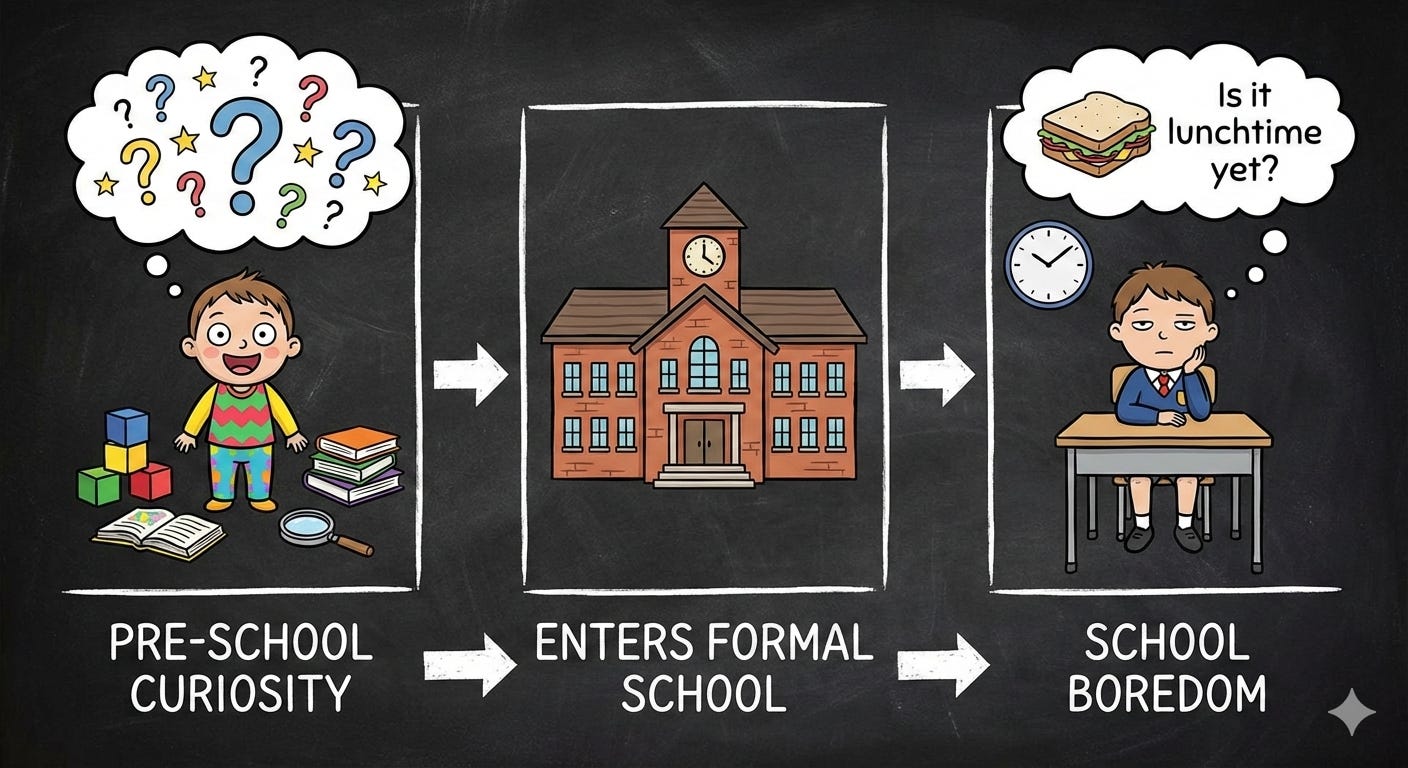
Schools often defend the lack of student autonomy, arguing that children ‘need’ to learn things they wouldn’t naturally choose. But this creates a false dichotomy. When we strip away all meaningful choice in the name of learning, we don’t allow students to choose “hard” things. My three-year-old didn’t only read books he initially found easy or interesting. He persisted through difficulty because the goal was his own.
The rigid structure of traditional schooling strips away student agency at nearly every turn. Students cannot choose what to learn, when to learn it, or how to demonstrate mastery. They’re told where to sit, when to eat, when to use the bathroom, and what constitutes acceptable thought on any given topic. The curriculum marches forward regardless of individual interest or readiness.
Grade Inflation Destroys Competence
Students develop competence when:
Expectations are clear
Feedback is honest
Mastery is required
Progress is real
Yet many schools pass students along without mastery in the name of ‘self-esteem.’ Inflated grades and social promotion may temporarily preserve confidence, but this is a house built on sand. Eventually, the student encounters a challenge that exposes the gap—a college course they can’t pass or a job requirement they can’t meet. The realization that they lack genuine competence is far more damaging than honest feedback would have been.
Students know when success is fake, and they adjust their behavior accordingly.
By the time they get to me in high school, they have figured out the system. They know they’ll be passed along with inflated grades or breeze through credit recovery courses by guessing on multiple-choice questions. Why would they put forth real effort when the system has taught them it’s unnecessary?
Relatedness Is Not “Being Nice”
In education, relatedness is often misunderstood as compassion without expectations.
That’s not what the research says.
Relatedness means:
Students believe adults care whether they succeed
Expectations feel rooted in concern, not control
Feedback is honest because the relationship is secure
Students are far more willing to struggle, revise, and persist when they trust the adult asking them to do so. That trust isn’t automatic. It’s earned through building a genuine relationship. Teachers who know their students as individuals can push them through difficult tasks because the relationship is secure. They function as mentors, not just instructors
This approach is far different than giving a student a “B” just because they don’t have two parents in the home. High standards with high support are vital to student success. Students will feel a greater sense of accomplishment by achieving something they perceive as impossible. This can only happen if we don’t lower our standards and embrace “equity grading.”
The Myth of the Unmotivated Student
From an SDT lens, most student behavior is entirely predictable.
If you remove autonomy, competence, and belonging, students will:
Do the bare minimum
Avoid challenge
Disengage emotionally
What Motivation-Supportive Schools Do Differently
Schools aligned with motivation science:
Require mastery, not promotion – Instead of moving all students to Chapter 5 on Monday regardless of readiness, they ensure each student has actually mastered Chapter 4 before advancing.
Offer real choices within structure – Rather than assigning the same essay to everyone, they might let students choose between writing an essay, creating a presentation, or leading a seminar discussion—all demonstrating the same core competencies.
Use feedback more than points – Students receive specific guidance on what they’ve mastered and what still needs work, not just a letter grade that obscures actual understanding.
Build strong adult–student relationships – Teachers know their students as individuals with unique strengths, struggles, and stories.
Treat learning as human, not mechanical – They recognize that education isn’t about processing children through a standardized system, but about developing thinking, capable people.
Final Thought
We’ve built an education system that continuously destroys what it claims to cultivate: motivated learners. If we want students actually to care about learning and be truly motivated to succeed, they need:
Agency instead of compliance
Honesty instead of grade inflation
Mentoring instead of supervision
If you appreciate this article and want to show support, please consider subscribing or buying me a coffee . I appreciate everyone’s support and feedback!